
Colorado DMV Permit Practice Test 15
- Questions25
- Correct to pass20
- Passing score80%
- Minimum age15 years
-
1. In a work zone a flagger is directing traffic in a way that conflicts with the posted signs. Whom do you follow?
Show answer
Answer B: The flagger's directions
A flagger controls traffic through a work area that changes from day to day, and those instructions take precedence over the fixed signs and markings in that zone.
-
2. Why should cruise control be switched off on wet, snowy or icy roads?
Show answer
Answer B: It may keep feeding power to a wheel that has started to slip, and cancelling it costs you time
Cruise control holds a set speed regardless of grip, so it can add power just as a tire loses traction, and the extra step of cancelling it delays your response.
-
3. Reaching for a drink in the cup holder is which kind of distraction?
Show answer
Answer A: Manual and visual at the same time
Your hand leaves the wheel and your eyes flick down to find the cup, so a task that feels trivial takes away two of the three things driving needs.
-
4. An overhead lane-use control signal shows a steady red X above the lane you are traveling in. What does it require?
Show answer
Answer D: Leave that lane, because it is closed to you
A steady red X means road users are not permitted to use the lane beneath it, so you must move into a lane that is open.
-
5. A Colorado driver under 21 records a BAC of 0.04 on a first offense. How long is the revocation?
Show answer
Answer C: Three months
Colorado revokes the license of a driver under 21 whose BAC was between 0.02 and 0.079 for three months on a first offense, 24 months on a second and 36 months on a third.
-
6. Why are pedestrians and cyclists a special risk on unlit streets at night?
Show answer
Answer A: Dark clothing can make them invisible until they are very close
A person in dark clothing reflects almost no light and may not appear until they are inside your stopping distance, so cut your speed where people may be about.
-
7. Some crosswalks are marked with two transverse lines and others with a row of wide bars laid along the direction of travel. Why is the second pattern used?
Show answer
Answer B: It is far easier for an approaching driver to see
Longitudinal bar patterns are used where extra visibility is wanted, such as an uncontrolled crossing or one near a school, because they show up much better from a car.
-
8. You are approaching a narrow bridge where the road has one lane in each direction and no shoulder. What should you do about passing?
Show answer
Answer B: Do not pass on or near the bridge
A narrow bridge gives neither vehicle anywhere to go, so passing is prohibited there in the same way as on a hill or in a tunnel.
-
9. You began a turn from the wrong lane and are already inside the intersection. What should you not do?
Show answer
Answer A: Reverse in order to get back into the correct lane
Backing up in an intersection puts you into the path of traffic that cannot expect it; finish the movement and fix your position afterwards.
-
10. At many crossings the walk indication appears only after a button is pressed. What happens if a pedestrian does not press it?
Show answer
Answer B: The signal may cycle without showing a walk indication
An actuated pedestrian phase is called in by the pushbutton, so without it the controller may serve the vehicle movements alone.
-
11. What must you be sure of before you pull out to pass on a two-lane road?
Show answer
Answer A: That the road ahead is clear far enough for the whole pass
You need enough clear road to pull out, pass and return before any oncoming vehicle arrives, and you must judge that distance before you start.
-
12. You are entering an angle parking space on your right. What should you do?
Show answer
Answer C: Stay a little left of the space, then turn in between the lines
Keeping a little left of the space gives the front wheels the room to turn in cleanly and leaves your car centered between the lines.
-
13. Where is the no passing zone pennant sign installed?
Show answer
Answer A: On the left side of the roadway
The pennant is placed on the left side of the roadway at the beginning of the no-passing zone, in the field of view of a driver who is thinking about overtaking.
-
14. A broken white line separates your lane from the lane on your right. What does it permit?
Show answer
Answer C: Changing lanes when it is safe to do so
A normal broken white line marks a boundary between lanes traveling the same way that road users may cross when it is safe.
-
15. You face a red light at an intersection that has no stop line and no marked crosswalk. Where must you stop?
Show answer
Answer C: Before entering the intersection
With no line and no crosswalk, the stopping point is the near edge of the intersecting roadway, close enough to see cross traffic but clear of it.
-
16. A sign reads END SCHOOL ZONE. What does it tell a driver?
Show answer
Answer A: The regular limit for that road applies again
An end of restriction sign marks the downstream limit of a special zone, after which the ordinary speed limit for that road governs again.
-
17. You have begun to move into the next lane when the gap you were aiming for closes. What is the safest action?
Show answer
Answer C: Return to your own lane, cancel the signal and wait for a better gap
An unfinished lane change leaves you in a space that no longer exists, and the lane you came from is still yours.
-
18. The queue for an exit ramp has backed up into the right lane of the highway. What should you do if you want that exit?
Show answer
Answer B: Join the back of the queue in the lane instead of cutting in later
Passing a queue and forcing in at the front stops the whole line, and using the shoulder puts you where broken-down vehicles are expected to be.
-
19. A sign on a freeway restricts trucks to the two right-hand lanes. What should a car driver expect in those lanes?
Show answer
Answer A: More heavy vehicles and slower changes of speed
A truck lane restriction concentrates heavy vehicles on the right, and those vehicles accelerate, brake and change lanes far more slowly than cars.
-
20. You reach a stretch of road covered by moving flood water of unknown depth. What is the correct decision?
Show answer
Answer D: Turn around and take another route
About a foot of moving water is enough to carry away most cars, and the roadbed under the water may already be washed out, so the only safe choice is to turn around.
-
21. A child has outgrown the rear-facing seat. What comes next?
Show answer
Answer D: A forward-facing seat with a harness, used up to its own stated limits
The stages run rear facing, then forward facing with a harness, then a booster, then the adult belt alone.
-
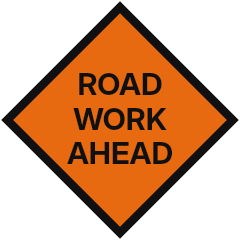
22. This sign is still standing late at night, and nobody is working. What should the driver assume?
Show answer
Answer B: The layout may still be altered, so the same care and reduced speed apply
Narrowed lanes, shifted alignments, dropped pavement edges and parked equipment remain overnight, so the hazard does not end when the crew goes home.
-
23. Why is passing another vehicle a bad idea in dense fog?
Show answer
Answer C: You cannot see far enough ahead to know the passing lane is clear
A pass needs a clear view of the road well beyond the vehicle you are overtaking, and fog takes exactly that away.
-
24. You hold steady pressure on the brake pedal for the whole of a long descent. What is likely to happen?
Show answer
Answer B: The brakes overheat and fade, so they slow you less and less
Continuous braking heats the brakes until they fade and lose effectiveness; use a lower gear and short, firm applications instead.
-
25. What should you do before you back out of your own driveway at home?
Show answer
Answer A: Walk around the vehicle and check behind it for children or objects
A small child, a bicycle or a toy can sit entirely inside the blind area behind a vehicle, and a walk-around is the only way to be sure it is clear.