
Colorado DMV Permit Practice Test 17
- Questions25
- Correct to pass20
- Passing score80%
- Minimum age15 years
-
1. A separate right-turn lane leads onto the cross street and carries a yield sign. What does it require?
Show answer
Answer D: Slowing and giving way to traffic and people, stopping if needed
A yield requires you to slow, give way to traffic in the lane you are joining and to pedestrians, and stop only if that is what safety demands.
-
2. At what tread depth should a tire be replaced?
Show answer
Answer A: When the tread is worn down to 2/32 of an inch
At that depth a tire loses grip quickly, especially on wet roads, and the built in wear bars or the penny test both show when the point has been reached.
-
3. A dust storm is blowing across the highway ahead of you. What is the recommended response?
Show answer
Answer B: Leave the road if you can, park well clear and take your foot off the brake
Get well off the pavement, switch the lights off and keep your foot off the brake, so drivers still on the road do not follow your tail lights off the highway.
-
4. A hot drink tips over onto your lap while you are driving. What should you do?
Show answer
Answer A: Keep hold of the wheel and stop when it is safe
The spill is painful but the crash risk comes from letting go of the wheel or braking suddenly, so keep control and deal with it once you are stopped.
-
5. A black on white regulatory sign at an intersection reads NO TURNS. What may a driver do there?
Show answer
Answer B: Only continue straight through the intersection
The NO TURNS sign bans turns in every direction at that intersection, so the only lawful movement from that approach is straight through.
-
6. Small green signs with white numerals posted at regular intervals along a highway are used to
Show answer
Answer B: show distance along the route and give a reference point for reporting a location
Reference location signs, commonly called mileposts, carry white numerals on green and let a driver describe exactly where a breakdown or crash has occurred.
-
7. You enter a work zone at night where one lane is closed and a flagger is on duty. What is the safest approach?
Show answer
Answer A: Slow early, merge before the closure and be ready to stop
Merging early at a reduced speed keeps the queue orderly and leaves you room to stop for equipment, workers or traffic that has halted ahead.
-
8. Which headlight setting should you use in dense fog?
Show answer
Answer B: Low beams
High beams reflect off the water droplets in fog and bounce glare back at you, while low beams aim downward and light the road without that mirror effect.
-
9. At a four-way stop you and an opposing driver arrive together. You are going straight and the other driver is turning left across your path. Who goes first?
Show answer
Answer B: You do, because the left turn crosses your path
When two opposing drivers arrive together, the one going straight goes first and the left-turning driver yields.
-
10. Do hazard lights make it legal to leave your vehicle in a no parking zone?
Show answer
Answer A: No, they warn other drivers but do not permit the parking
Hazard lights are a warning device, not a permit; the parking restriction applies whether they are flashing or not.
-
11. A sign beside the signal reads STOP HERE ON RED. What does it tell you?
Show answer
Answer B: Stop at that point on red, not closer to the intersection
The sign marks the required stopping point, which is set back from the corner so that turning vehicles and sight lines are not blocked.
-
12. You enter a corner faster than the turn can be taken. What is the most likely result?
Show answer
Answer A: The vehicle runs wide and may cross into another lane
Excess speed uses up the available grip, so the vehicle follows a wider arc than intended and drifts out of its lane.
-
13. What must a Colorado owner show before a vehicle can be registered?
Show answer
Answer C: Proof of an active Colorado auto insurance policy
Colorado will not register a vehicle without proof of active Colorado auto insurance meeting the state minimum liability limits.
-
14. What is sensible when you drive in an unfamiliar town for the first time?
Show answer
Answer C: Drive a little slower and give yourself more time to read the signs
In unfamiliar surroundings you need longer to take in signs, junctions and markings, and lower speed buys that time.
-
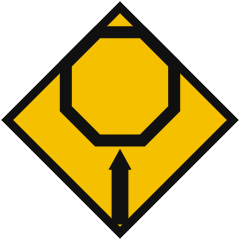
15. On a wet road, how should a driver adjust after passing this sign?
Show answer
Answer B: Start braking earlier, because a slippery surface lengthens the stopping distance
A wet surface lengthens stopping distance, so the extra warning distance should be spent braking gently and early instead of late and hard.
-
16. A pedestrian waiting at a curb faces a steady upraised hand. What does that indication mean?
Show answer
Answer A: Do not start to cross in that direction
A steady upraised hand forbids entering the crosswalk, while a flashing hand only forbids starting a new crossing.
-
17. Your passengers are being noisy and you are losing concentration. What should you do?
Show answer
Answer B: Ask them to settle down, or pull over safely until they do
The driver is responsible for the conditions inside the vehicle, and stopping is always better than driving distracted.
-
18. You are approaching the crest of a hill and cannot see the road beyond it. What should you do?
Show answer
Answer C: Slow down and keep well to the right
Beyond a blind crest there may be a stopped vehicle, a cyclist or an oncoming driver crossing the center line, so reduce speed and hold your own side.
-
19. The accelerator sticks open while you are driving. What is the first thing to do?
Show answer
Answer A: Shift into neutral and brake while steering off the road
Neutral disconnects the engine from the wheels so the vehicle can be braked normally, while shutting off the ignition may lock the steering and remove power assistance.
-
20. Your left-turn lane faces a steady green ball and oncoming traffic is heavy. What are you allowed to do?
Show answer
Answer C: Move into the intersection and turn when a safe gap appears
A green ball permits the turn but gives no priority, so you may move into the intersection and wait there for a gap in the oncoming traffic.
-
21. Which steering method gives the most control when you must turn the wheel a long way at low speed?
Show answer
Answer C: Hand over hand, feeding the wheel from one hand to the other
Hand over hand keeps both hands on the wheel through a large turn, so you never lose the ability to correct quickly.
-
22. You are stopped at a T-intersection and a driver on the through road is signaling a right turn into your road. What is the safe assumption?
Show answer
Answer B: The driver may not actually turn, so wait until the vehicle slows and starts turning
A blinking signal may have been left on by mistake or may be for the next street, so wait until the vehicle actually slows and turns.
-
23. A pedestrian with a white cane draws the cane back and steps away from the curb as you approach. What does that usually mean?
Show answer
Answer B: They are signaling you to go ahead and drive on
Pulling the cane in and stepping back from the curb is the customary way a blind pedestrian tells drivers to proceed.
-
24. Your brake pedal sinks to the floor and the vehicle does not slow down. What is a reasonable sequence of actions?
Show answer
Answer C: Pump the pedal, shift to a lower gear and apply the parking brake gradually while steering to a safe spot
Pumping can rebuild pressure in a partly failed system, a lower gear adds engine braking, and easing on the parking brake slows the vehicle without locking the wheels.
-
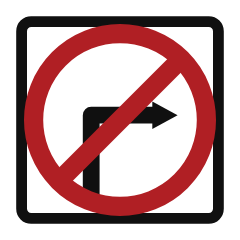
25. A driver's destination lies along the street to the right, and this sign stands at that corner. How should the driver reach it?
Show answer
Answer D: By going on and using a later intersection where turning is allowed
When a movement is barred at one corner the driver has to reroute, normally by continuing and coming back to the destination from a permitted approach.