
Colorado DMV Permit Practice Test 28
- Questions25
- Correct to pass20
- Passing score80%
- Minimum age15 years
-
1. A driver is thinking about overtaking a slower vehicle and sees this sign a short distance ahead. What does it mean for that pass?
Show answer
Answer B: The pass must be finished before the restricted section begins
The sign marks the start of a section where passing is prohibited, so a driver may not be on the left side of the road beyond it; any pass has to be completed before that point or not started at all.
-
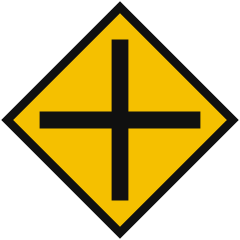
2. What should a driver expect a short distance beyond this sign?
Show answer
Answer C: Another road crossing the one being traveled
Traffic may enter or cross from either side at the intersection ahead, so the driver should ease off, cover the brake and check both approaches.
-
3. An oncoming driver flashes their headlights while you are waiting to turn left. What should you do?
Show answer
Answer D: Judge the situation yourself, since the flash may mean something else
A flash is not a legal signal and may mean many things, so the decision to turn stays yours and must be based on what you can see.
-
4. You are turning right from a one-way street onto a two-way street. Where should the turn end?
Show answer
Answer A: In the lane nearest the right curb of the street you are entering
A right turn starts and finishes as close to the right as practical, so you leave the one-way street from the right lane and arrive in the lane nearest the right curb.
-
5. Your right wheels have dropped onto a soft shoulder. Why should you not steer straight back onto the pavement?
Show answer
Answer A: The tires can catch the pavement edge and throw you across the road
A tire pressed against the edge of the pavement climbs it suddenly, and at speed that jolt can send the vehicle across the center line.
-
6. You realize at the last moment that you have passed the street where you meant to turn. What should you do?
Show answer
Answer D: Keep going and turn around where it is safe and legal
A missed turn is a minor inconvenience; braking suddenly, backing up or turning across traffic to recover it causes crashes.
-
7. You are turning right off a street into a parking lot driveway that crosses a bike lane and a sidewalk. Who has the right of way?
Show answer
Answer D: Pedestrians on the sidewalk and riders in the bike lane
Turning into a driveway means crossing the paths of people who were already traveling straight, so you give way to both the bike lane and the sidewalk.
-
8. How does a Colorado hearing officer set the length of a point suspension?
Show answer
Answer D: A base of six months, adjusted up or down, up to a one-year maximum
The hearing officer must enter a suspension once the points are sufficient, and starts from a base period of six months, adjusting for aggravators and mitigators up to a maximum of one year.
-
9. What is the main limit of stability and traction control systems?
Show answer
Answer B: They cannot create grip that the tires and the road do not have
These systems manage the grip that exists. If you enter a curve too fast for the surface, no amount of electronics will hold the vehicle on the road.
-
10. Why is smooth, early braking better than hard, late braking?
Show answer
Answer D: It keeps you in control and gives the driver behind more warning
Braking early and gently keeps the tires well within their grip and gives following drivers time to react to your brake lights.
-
11. A rectangular marker with alternating black and retroreflective yellow stripes set at a slant is used to
Show answer
Answer C: mark an obstruction, with the stripes sloping down toward the side on which traffic should pass
This striped panel is an object marker, and the direction in which the stripes slope shows the driver which side of the obstruction to pass on.
-
12. You are about to drive a rental car that you have never driven before. What should you do?
Show answer
Answer A: Adjust the seat and the mirrors and find the controls before moving off
Hunting for the wipers or the lights in traffic is a distraction, so learn the layout while the vehicle is stopped.
-
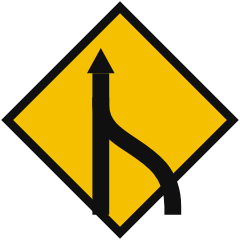
13. What is the safest way to deal with the situation this sign announces?
Show answer
Answer B: Match the speed of the other traffic stream and open a gap so vehicles can blend without hard braking
Blending works when speeds are matched and gaps are opened, so nobody has to brake hard or swerve where the two streams come together.
-
14. You wait in the aisle with your signal on for a space that is about to be vacated. What is the risk?
Show answer
Answer D: You block the aisle and drivers behind may try to squeeze past
A stopped vehicle turns a two-way aisle into a bottleneck, and drivers who try to get around it pass close to pedestrians and reversing cars.
-
15. The route marker used for an Interstate highway is a shield with
Show answer
Answer A: white numerals on a blue field under a red band carrying the word INTERSTATE
The Interstate route marker is a cutout shield with a white border, the word INTERSTATE in white on red across the top and the route number in white on blue.
-
16. You are already inside an intersection when you realize you should be in the lane beside you. What should you do?
Show answer
Answer C: Stay in your lane through the intersection and change lanes afterwards
Drivers in an intersection are watching for cross traffic and turning vehicles, so an unexpected sideways move there is easily missed.
-
17. A left-turn bay opens ahead of the intersection with a solid white line beside it. Where should you enter the bay?
Show answer
Answer C: At the opening before the solid line begins
The solid line marks where lane changes are no longer intended, so you move into the turn bay at its opening rather than cutting across the line later.
-
18. A broken white line separates your lane from the lane beside it. What does it indicate?
Show answer
Answer C: Both lanes carry traffic in the same direction and lane changes are permitted
White lines separate lanes of traffic moving in the same direction, and a broken white line means changing lanes across it is permitted when it is safe.
-
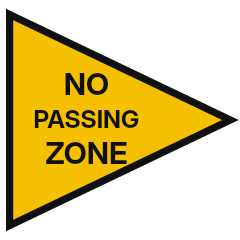
19. A yellow pennant-shaped sign is posted on the left side of a two-lane road facing you. What is it telling you?
Show answer
Answer B: You are entering a no-passing zone and may not start a pass
The pennant is placed on the left so that it faces the driver who might pull out, and it marks the beginning of a no-passing zone.
-
20. What does Colorado law allow a driver younger than 18 to do with a cellphone while driving?
Show answer
Answer A: Nothing except contacting help in an emergency
Colorado prohibits drivers younger than 18 from using a cellphone for any purpose while driving, with an exception only for emergency situations.
-
21. What does the Colorado Move It Law require after a minor crash on a divided highway?
Show answer
Answer B: Move the vehicles off the highway when they are drivable, no drugs or alcohol are involved and nobody is injured
Colorado requires drivers in a minor crash on a divided highway to move their vehicles off the road when the vehicles are drivable, no drugs or alcohol are involved and there are no injuries, and confirms that insurers will not penalize the move.
-
22. The signal ahead has a sign prohibiting left turns, and your route needs a left. What should you do?
Show answer
Answer D: Go straight on and find a legal place to turn and come back
A turn prohibition applies to every driver, so you continue through and reach your route by another legal turn.
-
23. You are turning onto a street that has two lanes going your way. Which lane should you enter?
Show answer
Answer B: The lane closest to you, changing lanes later if you need to
Turn into the nearest lane going your direction and make any lane change afterwards, when you have signaled and checked that it is clear.
-
24. A lane along the right edge is set off by a solid white line and marked with a bicycle symbol. How should a driver treat it?
Show answer
Answer B: Stay out of it except for the short distance needed to turn or cross where that is allowed
A marked bicycle lane is set aside for bicycle traffic, and motor vehicles may enter it only briefly where turning or crossing is permitted.
-
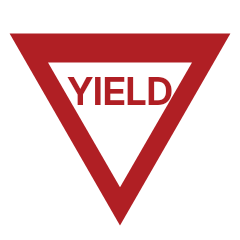
25. A driver reaches this sign and the intersecting roadway is completely clear. What is required?
Show answer
Answer D: Slowing to a speed that allows stopping, then going on without stopping if the way stays clear
This control asks the driver to slow down and be ready to stop, and a full stop becomes necessary only when traffic or pedestrians would otherwise be interfered with.