
Colorado DMV Motorcycle Practice Test 13
- Questions25
- Correct to pass20
- Passing score80%
- Minimum age16 years
-
1. It is very hot and a rider is tempted to take off the riding jacket. Why can that make the heat worse?
Show answer
Answer C: A bare arm in hot moving air loses fluid fast and burns in the sun
In hot, dry air a covering layer slows the evaporation of sweat and blocks the sun, so ventilated gear can keep a rider cooler and better hydrated than bare skin.
-
2. You have a steady green ball to turn left, and the oncoming traffic gets a green left arrow. What does that mean for you?
Show answer
Answer C: Oncoming vehicles will turn across your path, so you must wait
A green ball is permissive, so when the oncoming side receives a protected arrow those vehicles have priority and you must yield until they clear.
-
3. A traffic signal is dark and you reach the intersection at the same moment as a vehicle on your right. Who goes first?
Show answer
Answer A: The vehicle on your right, as at any all-way stop
A dark signal is treated as an all-way stop, and the usual tie-breaker then applies: the vehicle on the right goes first.
-
4. As a general rule, how far should you travel along a center two-way left-turn lane before you turn?
Show answer
Answer C: Only a short distance, just enough to slow down and wait for a gap
The center lane is for making or preparing a left turn, so you enter it only shortly before the turn and never travel along it as a through lane; several states set a specific limit such as 200 or 300 feet.
-
5. A sign warns that your exit leaves from the left side of the freeway. What should you do?
Show answer
Answer D: Move into the left lane in good time before you reach the exit
Left-hand exits are unusual, which is exactly why they are signed well in advance and why the lane changes should be finished early.
-
6. You are approaching a traffic light that has been green for a long time. How should you treat it?
Show answer
Answer C: Expect it to change and be ready to stop
A light that has been green for a while is called a stale green light. Cover the brake and decide in advance where you could still stop safely.
-
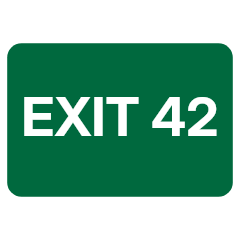
7. A driver in the left lane of a freeway realizes only when level with this sign that the ramp beside it is the one they need. What is the correct action?
Show answer
Answer A: Carry on to the next interchange and turn back from there
There is no safe way back to a ramp once it has been reached from the wrong lane, so the driver keeps going to the next interchange, where the ramps are built for that movement.
-
8. Which rain suit is the better choice for a rider?
Show answer
Answer A: A bright one with reflective panels, since rain cuts visibility
Drivers see less in the rain, so rain gear is exactly where bright color and reflective material pay off most.
-
9. In heavy stop-and-go traffic, why does using both lanes right up to a merge point help?
Show answer
Answer D: It stores the queue in two lanes, so the backup is shorter
Filling both lanes halves the length of the queue and keeps it away from the traffic upstream, which is why alternating at the merge point works better when traffic is slow.
-
10. You are about to slow down sharply for a turn. Which check comes first?
Show answer
Answer A: A look in the mirror to see how close the traffic behind you is
Any hard slowing needs a mirror check first, because the driver behind is the one who has to react to it.
-
11. You are stopped in a line of traffic on a steep uphill grade. What should you do about the gap to the vehicle ahead?
Show answer
Answer B: Leave more room than usual, because vehicles can roll back as they pull away
A vehicle ahead can roll back a foot or more as its driver releases the brake, and a motorcycle stopped tight behind it has nowhere to go.
-
12. A pedestrian waiting at a curb faces a steady upraised hand. What does that indication mean?
Show answer
Answer A: Do not start to cross in that direction
A steady upraised hand forbids entering the crosswalk, while a flashing hand only forbids starting a new crossing.
-
13. A United States numbered route is normally marked with
Show answer
Answer C: black numerals on a white shield
The U.S. route marker is a white shield carrying black numerals, which sets it apart at a glance from the red, white and blue Interstate shield.
-
14. What does a light drag of the rear brake do during a slow, tight turn?
Show answer
Answer C: It steadies the motorcycle and smooths out the power reaching the rear wheel
Working the rear brake against a slipping clutch takes the jerkiness out of the drivetrain and holds the machine steady through the turn.
-
15. You are about to pull out from a stop sign. Which scanning habit is correct?
Show answer
Answer A: Look to the left, then to the right, then to the left again before moving
Traffic from the left reaches you first, and a second look left catches anything that arrived while you were looking right.
-
16. You are very angry after an argument and about to drive. What should you know?
Show answer
Answer A: Strong emotions can impair judgment and attention much like alcohol
Anger, grief and stress pull attention inward and encourage risk taking. Give yourself time to settle down before getting behind the wheel.
-
17. Why is it harder to read the road surface at night once it has rained?
Show answer
Answer B: The wet surface throws light away and hides holes and markings
Light from your headlight bounces off wet pavement instead of coming back to you, and reflections of other lights mask the surface, so slow down and open up your following distance.
-
18. How can a first-time violator of Colorado's hands-free law have the charge dismissed?
Show answer
Answer D: By providing proof of purchasing a hands-free accessory
Colorado allows a first-time violator to have the charge dismissed on proof that they have purchased a hands-free accessory.
-
19. What should a rider look for in rain gear?
Show answer
Answer A: A riding rain suit that fits close and will not balloon or tear at speed
Rain gear designed for riding stays sealed and stays put in the airstream, while loose garments can flap, tear or interfere with the controls.
-
20. What penalty does Colorado's hands-free law impose for a first offense?
Show answer
Answer C: A $75 fine and two license suspension points
Colorado's hands-free law starts at a $75 fine and two license suspension points for a first offense, with higher fines and more points for repeat offenders.
-
21. A motorcycle in your group develops a mechanical problem on a busy highway. What is the best response?
Show answer
Answer C: Signal the group off at the next exit or wide, safe pull off area
A narrow shoulder beside fast traffic is a dangerous place to gather, so the group moves on to a spot where every machine is well clear of the roadway.
-
22. A sign on a freeway restricts trucks to the two right-hand lanes. What should a car driver expect in those lanes?
Show answer
Answer A: More heavy vehicles and slower changes of speed
A truck lane restriction concentrates heavy vehicles on the right, and those vehicles accelerate, brake and change lanes far more slowly than cars.
-
23. Why is the center portion of the lane a useful default on an open road?
Show answer
Answer B: It keeps a space cushion on both sides and discourages lane sharing
From the middle of the lane the rider has room to move either way, and no driver sees an obvious gap alongside to squeeze into.
-
24. Where must the engine cut-off switch be set before the starter button will crank the engine?
Show answer
Answer A: In the run position
The cut-off switch sits in the ignition circuit, so the engine will not start or run while it is set to off.
-
25. Why should a rider glance down at the sidestand before pulling away?
Show answer
Answer A: A stand left down can catch the road and lever the rear wheel off the ground
A sidestand that is still down will dig into the pavement in a left turn and can lift the rear tire clear of the road.