
Colorado DMV Motorcycle Practice Test 27
- Questions25
- Correct to pass20
- Passing score80%
- Minimum age16 years
-
1. You park at the roadside on a hill, facing downhill. What keeps the motorcycle from rolling away?
Show answer
Answer D: Leaving it in first gear with the front wheel turned toward the curb
A motorcycle has no parking brake, so the transmission left in gear stops the wheel turning and the front wheel turned into the curb blocks any roll.
-
2. Which part of the space around your vehicle can you control best?
Show answer
Answer A: The space ahead of you
You choose your own following distance, so the gap in front is the space you truly control and the one that gives you time to react.
-
3. You enter a work zone where the top layer of pavement has been milled off, leaving a grooved surface. How should you ride?
Show answer
Answer B: Hold a relaxed grip and steady speed, and expect the tires to wander
Milled or grooved pavement makes the tires follow the ridges and the motorcycle feel unsettled, so relax on the bars, keep a constant speed and ride straight through.
-
4. A sign with a green background and a white legend normally provides
Show answer
Answer A: directions, distances and destinations
Green is the background color of the guide sign series, which names routes and destinations and gives the distance to them.
-
5. The rider ahead of you has just passed a slow vehicle on a two lane road. What does that tell you about your own pass?
Show answer
Answer C: Nothing, because you must judge the oncoming traffic yourself
Every pass uses up part of the gap, so the space that was ample for the rider ahead may be far too short by the time it is your turn.
-
6. A steady downward green arrow is displayed over a lane. What does it indicate?
Show answer
Answer C: The lane is open to traffic in your direction
A steady downward green arrow means the lane it points to is open to traffic traveling in your direction.
-
7. In Colorado, at what blood alcohol concentration may a driver be convicted of DUI per se?
Show answer
Answer D: 0.08 percent or more
Colorado's DUI per se offense applies when the driver's blood alcohol concentration is 0.08 percent or more at the time of driving or within two hours afterward, while a lower reading can still support a DWAI charge.
-
8. What do white lane lines painted between travel lanes indicate?
Show answer
Answer A: Traffic in the adjacent lane moves in the same direction as you
White markings separate lanes carrying traffic in the same direction and mark the right edge of the roadway.
-
9. How does Colorado treat uninsured and underinsured motorist coverage on an auto policy?
Show answer
Answer D: It is optional but is included unless rejected in writing
The Colorado Division of Insurance states that uninsured and underinsured motorist coverage is optional but will be included in the policy unless the customer rejects it in writing.
-
10. You leave a brightly lit service area onto a dark rural road. Why should you slow down for a while?
Show answer
Answer C: Your eyes need time to adjust, so at first you see less
Eyes take a few minutes to adapt from bright light to darkness, and during that time you can see much less than your headlights actually show.
-
11. An officer directing traffic faces you and holds one hand up with the open palm toward your vehicle. What does the gesture mean?
Show answer
Answer D: Stop before reaching the officer
A raised open palm shown toward a driver is the standard signal to stop.
-
12. How should a passenger swing their leg when getting off the motorcycle?
Show answer
Answer D: High and clear of the exhaust and the rear of the machine
A leg dragged low across the back of the motorcycle can catch the seat or the luggage and will find the hot exhaust, so it is lifted well clear.
-
13. Why is backing up on a freeway or on its shoulder prohibited?
Show answer
Answer A: Traffic arrives far too fast to expect a vehicle moving the wrong way
Freeway traffic closes on a stopped or reversing vehicle at highway speed and has almost no time to react to something moving against the flow.
-
14. Your exit from a three-lane highway is about a mile ahead on the right, and you are in the left lane. What should you do?
Show answer
Answer B: Start moving right now, one lane at a time
Plan ahead and change lanes one at a time well before the exit, so you never have to cut across several lanes at the gore.
-
15. How do stimulant drugs such as amphetamines or cocaine typically affect driving?
Show answer
Answer D: They can make the driver overconfident and more willing to take risks
Stimulants create a false sense of alertness and encourage aggressive, risky driving. When they wear off, sudden fatigue can follow.
-
16. Which quality matters most in a face shield?
Show answer
Answer B: It resists penetration and is free of deep scratches
A shield has to stop objects thrown up from the road and stay clear enough for undistorted vision, and it needs some airflow so that it does not fog.
-
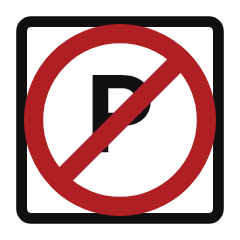
17. A driver leaves the vehicle at the curb where this sign is posted and walks away for two minutes. Is that allowed?
Show answer
Answer B: No, leaving the vehicle unattended there is prohibited whatever the length of the absence
Walking away leaves the vehicle parked, and the prohibition holds regardless of how long the driver is gone or whether the engine is left running.
-
18. When is a driver or rider most likely to need hand and arm signals instead of the vehicle turn signal lamps?
Show answer
Answer D: When the lamps have failed or cannot be seen because of glare or a load
Hand and arm signals replace or reinforce the lamps whenever the lamps do not work or cannot be seen clearly by other road users.
-
19. What is true about driving away from a crash you were involved in?
Show answer
Answer B: It is a serious offense, even if the other driver has driven away too
Leaving the scene is a criminal offense in every state, and the behavior of the other driver does not excuse it.
-
20. A car is waiting at a side street to pull out as you approach the intersection. What speed adjustment helps most?
Show answer
Answer B: Slow enough that you could still stop before reaching the intersection
Covering the brakes and reducing speed turns a possible collision into a stop the rider can actually make if the driver moves out.
-
21. What should a passenger be told about where to keep their legs?
Show answer
Answer D: To keep them away from the muffler, the chain and other moving parts
Exhaust pipes get hot enough to burn and exposed drive components can catch a loose leg, so the passenger must keep legs in and clear of them.
-
22. A driver is tailgating you. Why is it a bad idea to tap or stab the brakes to warn them?
Show answer
Answer C: Because it cuts the little space they have and can cause a crash
Brake checking removes the small margin the tailgater has left and can provoke a collision; add space in front of you instead and let them pass.
-
23. Why should reflective material be placed on the front, back and sides of a rider's gear?
Show answer
Answer D: A driver may approach the rider from any of those directions
Threats come from ahead, behind and from the sides at intersections, so reflective material should be visible from every direction a vehicle can approach.
-
24. Why is standing water across a road dangerous even when it looks shallow?
Show answer
Answer B: It can hide a washed out roadbed, a deep hole or a missing cover
You cannot see the surface under the water, and floods commonly wash the roadbed away or lift covers off drains.
-
25. You are at a red light where right turns on red are allowed, you cannot see clearly, and the driver behind sounds the horn. What should you do?
Show answer
Answer C: Stay stopped until you can see that the turn is safe
Turning right on red is permitted, never required, so you wait until you can see that the way is clear no matter what the driver behind does.