
Colorado DMV Motorcycle Practice Test 4
- Questions25
- Correct to pass20
- Passing score80%
- Minimum age16 years
-
1. How should a rider use the head and eyes in a turn?
Show answer
Answer A: Turn only the head to look through the turn, keeping the eyes level with the horizon
Turning just the head keeps the upper body from upsetting the motorcycle, and level eyes help the rider judge lean angle and direction.
-
2. Why is an underinflated tire especially risky on a long drive in hot weather?
Show answer
Answer C: It flexes more, builds up heat and can fail at speed
A soft tire flexes on every rotation, and that flexing makes heat that the hot road and high speed add to until the tire can come apart.
-
3. You are turning left at an intersection just beyond the crest of a hill. What is the added risk?
Show answer
Answer B: Oncoming vehicles appear with very little warning and close quickly
A crest hides approaching traffic until it is close, so the gap you thought was empty can fill in the time the turn takes.
-
4. The vehicle in front of you has stopped and is waiting to turn left, and there is a paved shoulder to the right. May you use it to get by?
Show answer
Answer D: No, in most states a pass may not be made by leaving the paved travel lanes
Passing on the right is normally lawful only inside the marked travel lanes, and most states prohibit driving onto the shoulder to get around a turning vehicle; the few states that allow it attach strict conditions.
-
5. Your group is turning left across oncoming traffic. What should you do?
Show answer
Answer D: Wait until you personally have a large enough gap to turn
Each rider needs a gap of their own, and turning on the strength of the rider ahead means turning into traffic you have not actually judged.
-
6. Under the Colorado Move Over Law, what must you do when you cannot safely change lanes for a stationary vehicle with hazards flashing on a road posted at 45 mph or more?
Show answer
Answer B: Slow to at least 20 mph below the posted speed limit
Colorado requires drivers to move over one lane when it is safe; where it is not safe or the road has one lane in each direction, they must slow to at least 20 mph below the posted limit on roads posted at 45 mph or more, or to 25 mph or less on roads posted below 45 mph.
-
7. After an officer confiscates a Colorado license and serves an Express Consent notice of revocation, how long does the driver have to request a hearing?
Show answer
Answer B: Seven calendar days
Colorado gives the driver 7 calendar days from the arrest, or from the date on the DMV letter after a blood test, to request an Express Consent hearing; missing it waives the right.
-
8. What is the correct technique for a maximum effort stop in a straight line?
Show answer
Answer A: Squeeze the front lever progressively and press the rear pedal, staying upright
Both brakes together give the shortest stop, the front is squeezed progressively as weight transfers forward, and the machine must be upright with the bars square.
-
9. Your front wheel drops off the edge of the pavement onto a lower shoulder. What is the safest way back?
Show answer
Answer D: Ride straight, slow down, then turn back sharply enough to cross the edge
Trying to climb a raised pavement edge at a shallow angle lets the tire slide along it, so the rider settles first and then crosses the edge at a sharp angle.
-
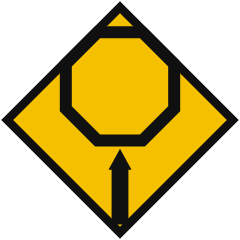
10. What is the driver expected to do after passing this sign?
Show answer
Answer A: Begin slowing so that a complete stop can be made at the intersection ahead
It is used where the control at the intersection stays hidden until late, so braking should begin here rather than at the stop line.
-
11. In which crash must the police always be notified?
Show answer
Answer D: Any crash in which somebody has been injured or killed, whatever the damage
Injury or death always makes a crash reportable, whatever the amount of vehicle damage or the opinions of the drivers.
-
12. A funeral procession with headlights on is crossing an intersection when your light turns green. What should you do?
Show answer
Answer A: Wait and let the whole procession go through
Most states let a funeral procession stay together once the lead vehicle has lawfully entered an intersection, and in every state you must yield to vehicles already in the intersection, so wait until the line has passed.
-
13. Another driver is behaving aggressively toward you. What should you do?
Show answer
Answer D: Avoid eye contact, give them room to go on their way and do not respond to provocation
Responding to an aggressive driver escalates the conflict, while creating distance and refusing to engage takes you out of the situation. Report serious threats once you can do so safely.
-
14. When may a passenger get off the motorcycle?
Show answer
Answer D: Only after the rider has stopped, braced the machine and said so
A passenger climbing off before the rider is ready removes weight from the back of a machine the rider is still holding upright, which can drop it.
-
15. A pedestrian is crossing a wide four-lane street and has reached the lanes on the far side. When may you go on?
Show answer
Answer C: Only after the person has finished crossing the roadway
Waiting until the pedestrian has finished crossing is correct in every state and removes any doubt about how much clearance your state demands.
-
16. What does Colorado law allow a driver younger than 18 to do with a cellphone while driving?
Show answer
Answer A: Nothing except contacting help in an emergency
Colorado prohibits drivers younger than 18 from using a cellphone for any purpose while driving, with an exception only for emergency situations.
-
17. Which ability does alcohol usually affect first?
Show answer
Answer A: Judgment and self control
Alcohol reduces judgment and inhibition before a drinker notices any clumsiness, which is why an impaired driver often feels perfectly capable while already driving worse.
-
18. Why is texting considered one of the most dangerous distractions?
Show answer
Answer B: It combines visual, manual and cognitive distraction at the same time
Reading or writing a message takes your eyes off the road, at least one hand off the controls and your attention off driving simultaneously.
-
19. You are on an entrance ramp merging onto a freeway. Who has to give way?
Show answer
Answer B: You must yield and fit into a gap in the traffic already on the freeway
Traffic entering a highway must yield to traffic already on it. Use the acceleration lane to match speed and merge into a gap.
-
20. How much space should the leader of a group keep behind the vehicle ahead of the group?
Show answer
Answer D: At least the normal following distance a rider would keep when riding alone
Riding in a group does not shorten the space a motorcycle needs to stop, so the leader keeps the same cushion any rider would keep alone.
-
21. A rectangular marker with alternating black and retroreflective yellow stripes set at a slant is used to
Show answer
Answer C: mark an obstruction, with the stripes sloping down toward the side on which traffic should pass
This striped panel is an object marker, and the direction in which the stripes slope shows the driver which side of the obstruction to pass on.
-
22. A pedestrian using a white cane or walking with a guide dog starts to cross the street ahead of you. What must you do?
Show answer
Answer A: Yield and stay stopped until the person has finished crossing
A white cane or guide dog identifies a pedestrian who may not be able to see your vehicle, so you must yield and wait rather than maneuver around the person. The horn can confuse the pedestrian or the dog.
-
23. How should a rider approach a curve whose radius keeps tightening the further you go into it?
Show answer
Answer A: Enter more slowly than the curve first appears to need, saving lean for the exit
In a decreasing radius curve the sharpest part comes last, so a slower entry leaves both speed and lean angle in reserve for where they are needed.
-
24. At roughly what speed can hydroplaning begin when a lot of water is lying on the road?
Show answer
Answer C: At speeds as low as about 35 mph
With enough water and less than perfect tread, a tire can start to ride on the water at around 35 mph, well below normal highway speeds.
-
25. After the leader of a staggered group completes a pass, what should the leader do?
Show answer
Answer A: Move to the left position and hold passing speed to open room for the next rider
Returning to the left position and keeping speed opens the gap the next rider needs to finish the pass and settle back into formation.